Continue reading
News en vrac / WP sandbox
I just discovered this macro available in C: offsetof. Here is an simple example:
struct { char a; int b; char c; } example; struct example s1; unsigned int offset; offset = (unsigned int)(&(((example *)(0))->b)); |
Thanks to offsetof (in the header stddef.h), the last line can be rewritten in:
unsigned int offset; offset = offsetof(example, b); |
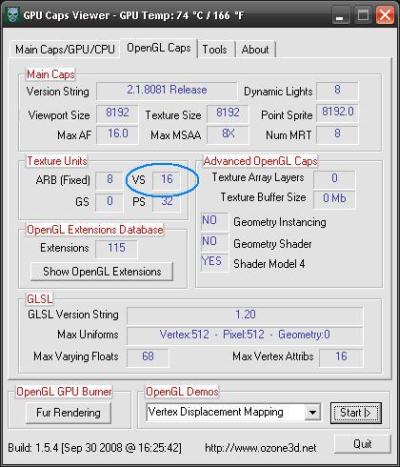
As I said in this news, the release of Catalyst 8.10 BETA comes with a nice bugfix: vertex texture fetching is now operational on Radeon (at least on my Radeon HD 4850). From 2 or 3 months, Catalyst makes it possible to fetch texture from inside a vertex shader. You can see with GPU Caps Viewer how many texture units are exposed in a vertex shader for your Radeon:
This very cool news makes me want to create a new benchmark based on VTF!
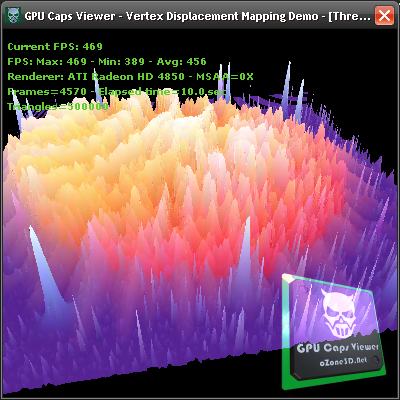
I’ve only tested the XP version of Catalyst 8.10. If someone has tested the Vista version, feel free to post a comment…
Next step for ATI driver team: enable geometry texture fetching: allows texture fetching inside a geometry shader…
See you soon!
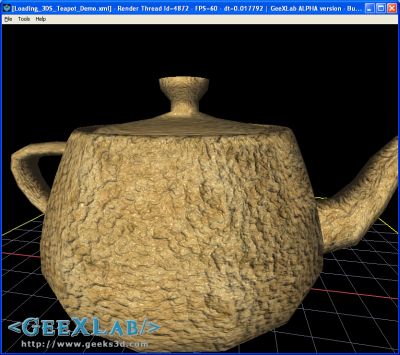
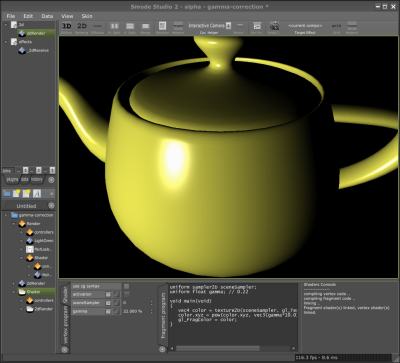
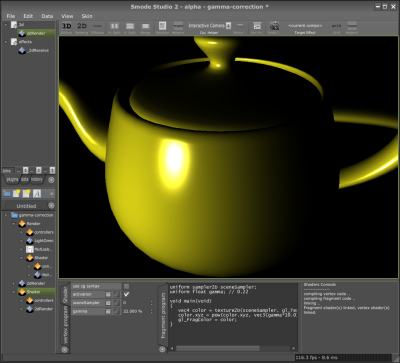
I’ve coded today a small gamma correction filter in Smode. I’ll talk about gamma correction a little bit more very soon with a Demoniak3D demo. Here is the result on a simple scene: a teapot lit with a Phong shader.
The following image shows the rendering of the scene done in the usual manner, I mean without gamma correction:
and now the same scene gamma-corrected (factor 2.2):
Under Visual Studio 2005 (VC8), you can enable the multithreaded build of projects. This great feature makes it possible to use several CPUs to build your projects. This is a per-project setting and it’s done in command line: /MPx where x is the number of cores you want to use. Example: /MP2 to use 2 CPUs if you have (like me) a core2duo.
I’ve done some tests with Demoniak3D:
– Demoniak3D (default): Build Time 0:33
– Demoniak3D (/MP2): Build Time 0:15
Great boost in productivity of large projects!
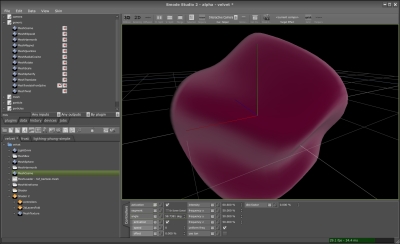
Dès que la prochaine release de Demoniak3D, la 1.24.0 (le numéro de version sera peut être le 1.30.0 vu le nombre de modifs), je releaserai la démo du velour avec son beau shader GLSL. Et si je tarde un peu, n’hésitez pas à me poster un petit message pour me rappeler à l’ordre.
[/French]
[English]
Are you ready for a small velvet GLSL shader? Here’s one, at least a preview of the one I’ve just coded for a demo with Smode. Smode… a software dedicated to create… demos! And the cool thing, is that Smode demos will be also available for Demoniak3D. Don’t look for Smode, it’s not available for you, public… Only few people on this planet are enough lucky to play with. But if you really want to touch it, just drop me an email…
As soon as the next release of Demoniak3D, the 1.24.0 (or better the 1.30.0 because of the huge amount of changes), will be ok, I’ll put online the velvet demo with its nice GLSL shader. And if I’m late, don’t hesitate to post a small message to wake me up!
[/English]
Packing a [0-1] float value into a 4D vector where each component will be a 8-bits integer:
vec4 packFloatToVec4i(const float value)
{
  const vec4 bitSh = vec4(256.0*256.0*256.0, 256.0*256.0, 256.0, 1.0);
  const vec4 bitMsk = vec4(0.0, 1.0/256.0, 1.0/256.0, 1.0/256.0);
  vec4 res = fract(value * bitSh);
  res -= res.xxyz * bitMsk;
  return res;
}
Unpacking a [0-1] float value from a 4D vector where each component was a 8-bits integer:
float unpackFloatFromVec4i(const vec4 value)
{
  const vec4 bitSh = vec4(1.0/(256.0*256.0*256.0), 1.0/(256.0*256.0), 1.0/256.0, 1.0);
  return(dot(value, bitSh));
}
Source of these codes: Gamedev forums
I found this cool random generator on rgba’s website. rgba is a wellknown demoscene group specialized in 4k prods. This random generator is used in their prods:
static unsigned int mirand = 1;
float sfrand( void )
{
    unsigned int a;
    mirand *= 16807;
    a = (mirand&0x007fffff) | 0x40000000;
    return( *((float*)&a) - 3.0f );
}
It produces values in the range [-1.0; 1.0].
You can find the making of this random gen HERE.
Here is a small piece of code that can be useful if you need to quickly generate traces (or log) in your apps:
class cLog
{
public:
  cLog(char *logfile){};
  static void trace(const char *s)
  { if(s) log <<  s << std::endl; };
  static std::ofstream log;
};
std::ofstream cLog::log("c:\\app_log.txt");
Just use it as follows:
cLog::trace("this is a log");
cLog::trace("this is a second trace");